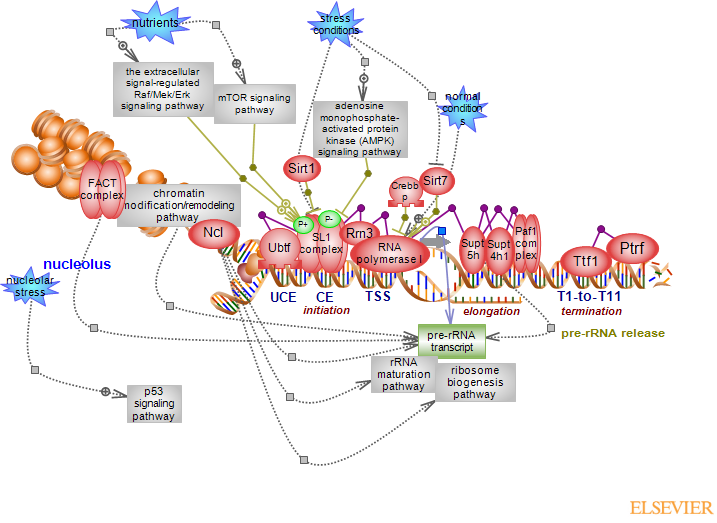
The three eukaryotic RNA polymerases (RNAPs)- Pol I, II and III, transcribe different sets of genes and require distinct sets of factors to assemble a specific initiation complex which recruits them on gene promoters. The multi-subunit enzymes are composed of 14 (RNAPI), 12 (RNAPII) and 17 (RNAPIII) sub-units of which some are shared and others are unique, yet converging on an overall similar structural topology. Complexes specific to each of the three systems share the universal transcription
factor 'TATA-box binding protein' (TBP) regardless of whether the promoters have a TATA box or not. In addition, modules and domains present in general transcription factors (GTFs) specific for RNAPII are found in subunits of RNAPI and RNAPIII and/or RNAPI and RNAPIII specific factors. The initiation, elongation and termination of transcription are steps shared by all systems, albeit with differing details and/or degrees of complexity. Beyond the shared or related elements, specific factors confer unique topological and functional features to the particular initiation complex associated with the three polymerases and account for the differences in promoter recognition and the class or category of transcribed genes. Pol I transcribes ribosomal RNA, all protein-coding and many non-coding genes are transcribed by pol II, while transfer RNA, the small 5S ribosomal RNA and a subset of small non-coding genes are the realm of pol III mediated transcription. Transcription by RNA pol I is described here.
RNA polymerase I transcription pathway RNAPI transcription takes place in the nucleolus and its single target is the gene encoding the large ribosomal 47S mammalian precursor (35S in yeast), subsequently processed into the three mature 18S, 28S and 5.8S rRNAs. Co- and post-transcriptional events produce the mature rRNA. An additional rRNA gene, the 5S rRNA is transcribed by RNAPIII, the genes encoding the many ribosomal proteins are the targets of RNAPII transcription. Together they form the ribosomes whose assembly is assisted by a plethora of accessory factors. There are multiple copies of the rRNA gene organized in large clusters at Nucleolar Organizer Regions (NORs). In mammals, there are ~400 copies of rRNA in gene clusters on multiple chromosomes and like in yeast, only a fraction is actively transcribed. Within each cluster the rRNA genes are arranged in a head-to-tail orientation of alternating transcribed and non-transcribed rRNA genes. Pol I promoter is bipartite with a core element (CE) that overlaps with the transcription start site (TSS) and an upstream control element (UCE) that is ~ 100 bp upstream of TSS. The formation of the pre-initiation complex involves binding of Ubtf dimer to UCE and recruitment of SL1 selectivity complex to CE. Human Ubtf contains a series of tandem high mobility group (HMG) boxes that bind and bend DNA. Human SL1 complex contains TBP, four pol I TBP associated factors (TAFs) TAF1A, B, C and D, and TAF12 - a component of pol II complexes TFIID and SAGA. The N-terminus of TAF1B shares homology with TFIIB and the N-terminus of Brf1 component of TFIIIB - the essential GTFs of Pol II and III, respectively. While TBP is a component of SL1 and required for Pol I transcription, it is not clear whether is necessary for basal transcription, suggesting a possible role as a coactivator to facilitate the interaction between Ubtf and SL1. An yeast ortholog, Rrn3 interacts with the TAF1A and B subunits of SL1 and is probably involved in pol I recruitment. Pol I is composed of 14 subunits of which seven are shared with Pol III and of this set, five are shared with Pol II. The FACT complex modulates the chromatin structure to promote transcription The FACT chromatin modulator is composed of SSRP1 and SUPT16H, is thought to act as a histone chaperone and mediate nucleosome reorganization, and it facilitates replication, transcription and DNA repair. FACT associates with and is important for transcription by Pol I and the other two Pol systems; DNA binding is important for its recruitment. Both proteins interact with Pol I subunits while the HMG domain of Ssrp1 probably mediates DNA binding. FACT also interacts with the Paf1 complex involved in elongation. The Paf1 complex (Paf1C) increases the elongation rate of pol I and is also important for Pol II transcription. The complex is composed of five subunits and an additional one is present in human cells. RNAPI has intrinsic RNA hydrolysis and elongation promoting activities. The POLR1E/Paf53/A49 and CD3EAP/Paf49/A34.5 subunits of Pol I have TFIIF-like domains; TFIIF is the Pol II transcription factor whose many roles include enhancement of elongation. The Supt4h1/5h heterodimer (Spt4/5), known for its implication in Pol II transcription elongation, also affects elongation by pol I. Supt5h interacts with both Pol I and II; interactions between the heterodimer and Paf1 complex are reported. Nucleolin - a gene found in all animal, plant and yeast species, regulates the pre-rRNA transcription and processing, and ribosome biogenesis. It binds DNA and like FACT, has chromatin activities. Termination of transcription by Pol I requires the recruitment of factors to specific DNA elements known as terminators - T1-to-T10 or T11 in mouse and human, respectively. Ttf1 binds to terminator elements leading to bending of DNA, that is recognized by Pol I and stops transcription. Release of the primary transcript is catalyzed by Pol I and the release factor Ptrf, originally identified as a Ttf1 interacting partner.
Ribosome biogenesis is energetically very expensive. As such, rRNA synthesis is heavily regulated in response to environmental cues: it is activated in response to nutrients and is repressed in response to stress. Under normal conditions, POLR1E/Paf53/A49 subunit is associated with the histone acetyltransferase Crebbp/Cbp and the NAD+ dependent deacetylase Sirt7. CBP acetylation is reversed by Sirt7; hypocetylation of POLR1E facilitates its association with rDNA and is required for Pol I transcription. On the other hand, Sirt1 deacetylation of TAF1B in response to stress, has an inhibitory effect by impairing binding of SL1 complex to promoters. Stresses activate kinases such as AMPK phosphorylate TAF1A at particular residues and inhibit transcription. Impaired transcription results in lack of nascent pre-rRNA, whose binding by Sirt7 is essential for the nucleolar retention of the enzyme. Consequently, POLR1E stays acetylated leading to reduced rDNA occupancy by Pol I. However, TAF1A phosphorylation at other residues by nutrient and mitogen activated kinases such as mTOR and Erk1/2, is required for Pol I transcription, with mTOR exerting dual effects. Chromatin modification and remodeling play a critical role in delineating the active or silent rRNA promoter states; non-coding RNAs may further contribute to the control of epigenetic regulation. Nucleolar stress activates the p53 signaling to arrest cell cycle or, if necessary, to induce apoptosis. Oncogenes and tumor suppressors influence Pol I transcription. Its connection to cell growth and proliferation makes it a candidate for the development of cancer therapeutics. To see the ontology report for annotations, GViewer and download, click here...(less)