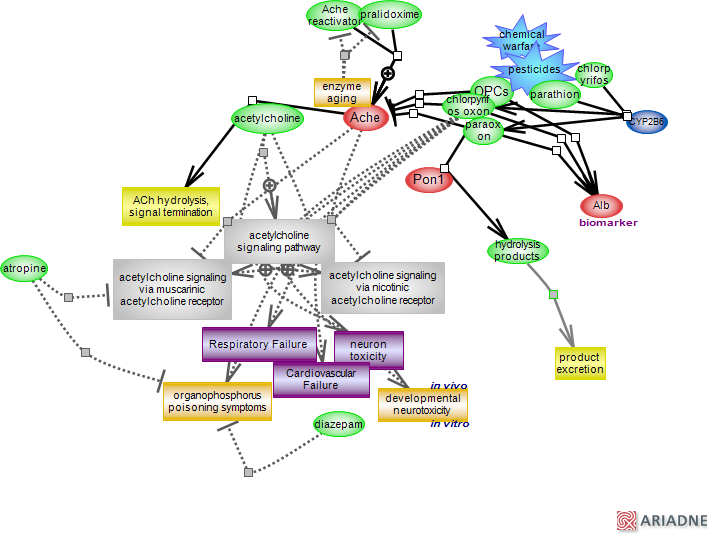
Organophosphorous compounds (OPCs) are used as pesticides in agriculture, particularly as insecticides, and occasionally in industrial settings. As nerve agents, they have been used in warfare in the past; OPCs have been used in modern chemical warfare and in terrorist attacks. In some countries, OPCs are used for self-poisoning. OPCs poisoning, whether accidental from occupational exposure or intentional, is a serious public health issue. The main mechanism of toxicity is the inhibition of ace
tylcholinesterase AChE resulting in uncensored acetylcholine (ACh) signaling. ACh is a neurotransmitter and neuromodulator that plays important roles in the central and peripheral nervous system and also in non-neuronal cells. It performs its manifold functions by activating the ionotropic nicotinic (nAChRs) and the metabotropic (mAChRs) receptors. [To see acetylcholine signaling via nicotinic receptors click here, via muscarinic receptors, click here and for an overall depiction of the acetylcholine system, click here]. The signal is terminated by the hydrolysis of ACh by Ache - a very fast acting enzyme accounting for ACh clearance in less than a millisecond (click the see the structure of the apo human enzyme; or in combination with the anti-Alzheimer drug Donepezil. OPCs poisoning leads to neuronal excitotoxicity and damage and affects the cardiovascular, musculoskeletal, respiratory and gastrointestinal systems. A primary cause of death is respiratory failure due to muscle paralysis, bronchial and brain respiratory systems dysfunction; cardiovascular failure can also occur. In vivo and in vitro studies in rats show a range of developmental neurotoxic effects of OPCs. Structurally, OPCs are ester, thiol or amide derivatives of phosphoric acid, phosphonic acid or phosphinic acid and hundreds different compounds are available. The mechanism of Ache inactivation involves the formation of a covalent bond between the OPC's phosphoryl group and the hydroxyl group of a serine residue in the active site of Ache; the inactivation is largely irreversible. Some of the extensively used insecticides, such as parathion and chlorpyrifos are phosphorothionates. The oxidative desulfuration of P=S moiety is carried out by members of the cytochrome P450 family, CYP2B6 primarily. The resulting 'oxon' metabolites - paraoxon and chlorpyrifos oxon, respectively, are the potent Ache inhibitors. Some OPCs metabolism is carried out by paraoxonases - arylesterases that can hydrolyze OPCs. Pon1 is a primary esterase; the calcium-dependent enzyme catalyzes the hydrolysis of cyclic lactones such as homocysteine thiolactone. Pon1 has a broad substrate specificity which probably accounts for its activity towards OPCs and other xenobiotics (click to access the PDB entry for the crystal structure). The finding that the parathion derived paraoxon metabolite is a substrate for PON1, lead to its identification as a phosphotriesterase. Parathion, still in use in parts of the world, has been banned in the United States and other countries; its place taken by the related but less toxic methyl parathion. Several approaches are used to counteract OPCs poisoning (OPP), largely with relative efficacy. Oximes, also known as cholinesterase reactivators, are chemical compounds aiming at restoring (reactivating) the Ache by splitting the OPC-enzyme bond. Of the several commercially available, pralidoxime is the most commonly used. Their efficacy varies and many do not cross the blood-brain barrier thus limiting their effect on the central nervous system. Oxime administration must be fast as the phosphorylated Ache can undergo 'aging' - a time-dependent loss of one alkyl group bound to phosphorous which prohibits the reactivation reaction. Other approaches do not involve actual anti-OPCs but are used because their actions can alleviate some of the symptoms of PCs, poisoning. They include atropine - a competitive antagonist for the muscarinic receptors that reduces several of the symptoms and diazepam, one of a class of benzodiazepines with depressant functions, as an anticonvulsant. A standard therapy consists of combinations of oximes, atropine and diazepine. In addition to Ache, OPCs form adducts on several other proteins, the most notable example being albumin. The phosphorylated tyrosine - documented in humans and mice, is not subject to aging or substrate for oximes; this coupled to the high abundance and long half-life of the protein renders albumin as useful biomarker for OPC exposure despite a lower reaction rate, compared to Ache. click to see the ontology report for annotations, GViewer and download....(less)