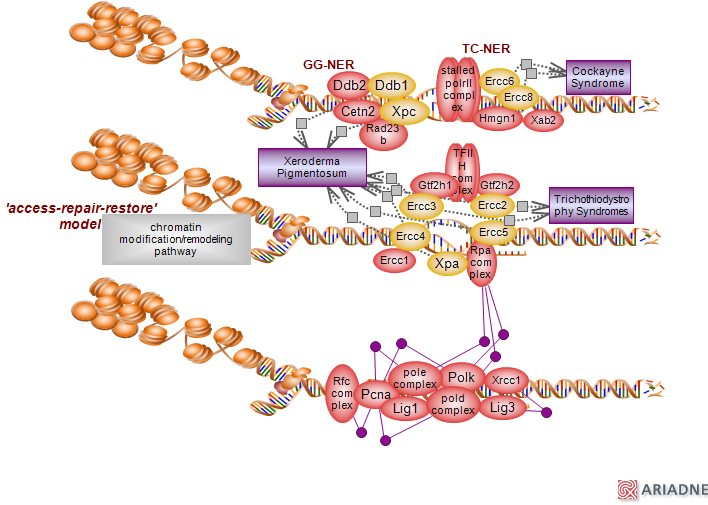
DNA lesions, induced by endogenous or exogenous agents, affect the faithful replication of the genome resulting in genetic aberrations that can be deleterious to the cell and organism. Multiple systems have evolved to detect single and double-strand DNA lesions, initiate signals that can be amplified and propagated, and set in motion effectors that can impinge upon DNA repair and checkpoint, various signaling and/or regulatory pathways, as necessary. Together, this vast response mechanism is kn
own as the DNA Damage Response (DDR) pathway whose elements may operate collectively with shared components. The nucleotide excision repair (NER) pathway, is a versatile single-strand DNA repair pathway and part of DDR. It targets various, structurally unrelated DNA modifications that result in distortion of the double helix. NER is subdivided into two sub-pathways that differ in the first step of lesion recognition. The transcription-coupled TC-NER is involved in the repair of lesions within the transcribed strand of active genes whereas the global genome GG-NER is involved in the repair of lesions throughout the genome. The two converge into the core of NER leading to cleavage of the damaged strand on either side of the lesion and excision of a stretch of about 24-32 nucleotides followed by re-synthesis of the missing DNA stretch and ligation. In humans, inborn defects in almost one third of the proteins involved in NER have been implicated in xeroderma pigmentosum (XP) and premature aging-like disorders such as Cockayne syndrome (CS) and trichothiodystrophy (TTD). The affected proteins are either components of the initial lesion recognition/components recruitment step or the subsequent step of lesion processing/lesion release. To access the diagram for the normal excision nucleotide repair pathway, click here .The affected proteins, their role and disease association are described below.
In TC-NER, the stalled polymerase II (PolrII) complex acts as the damage sensor recruiting TC-NER specific factors of which Cockayne syndrome CSA and CSB, the Ercc8 and Ercc6 genes, play essential, but partially understood roles. Ercc6 binds stalled PolrII while Ercc8 interacts with Ercc6, Hmgn1, Xab2 and the Gtf2h2 subunit of TFIIH. Mutations in these proteins, as the name suggests, are implicated in CS, characterized by slow and abnormal growth and development.
In GG-NER, lesions are recognized by Xpc within the Xpc-Rad23b-centrin2 complex and certain types of lesions by the UV-DDB complex (Ddb1-Ddb2-containing E3-ubiquitin ligase complex). TC-NER and GG-NER converge into the core of NER which includes the recruitment of TFIIH, a multi-subunit complex and a component of RNA polymerase II pre-initiation complex (PIC). Two of its subunits ¿ Ercc2 and Ercc3 are ATP-dependent helicases that open the damaged DNA. Subsequent recruitment of Xpa and Rpa leads to recruitment of incision endonucleases Ercc5 and Xpf-associated Ercc4. Following release of the ~30 nucleotide long DNA fragment, DNA synthesis and ligation take place. Mutations in the two helicases and a third component of TFIIH complex ¿ Gtf2h5, have been associated with photosensitive TTD, characterized by physical and mental retardation and other physical abnormalities. Gth2h5 is believed to be dispensable for NER and/or transcription; a mouse knock-out shows complete NER deficiency and embryonic lethality.
XP is a rare autosomal recessive disease whose patients display extreme photosensitivity to ultraviolet (UV) light, have multiple skin cancers and other abnormalities. Complementation studies showed that several genes are involved in the disease: the two helicases Ercc2 and 3, the two endonucleases Ercc4 and Ercc5, Xpa, and the two lesion recognition components of GG-NER, Xpc and Ddb1.
The affected proteins are shown color-coded (yellow) with relationships removed and the conditions indicated. It is to be mentioned here that although the three conditions described involve components of the same pathway, the clinical manifestations are extremely diverse and even the same mutation affects the individuals carrying it in different ways. To see the ontology report for Gviewer, annotations and download, click here ...(less)
in silico assessment of alteration of DNA-protein, protein-protein interactions and observed reduction of DNA repair capacity in the context of nucleotide excision repair pathway for SNP