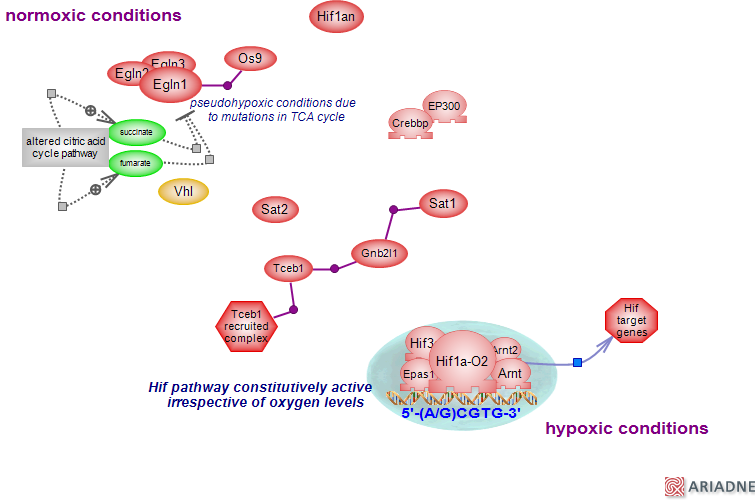
Hypoxia inducible factor (Hif) pathway is the master regulator of oxygen homeostasis. Under normoxic conditions, the Hif alpha proteins are subject to hydroxylation by prolyl and asparagyl hydroxylases whose own enzymatic activities are oxygen dependent and require iron and 2-oxoglutarate as cofactors. The modified prolines are recognized by Von Hippel-Landau (Vhl), the component of E3 ubiquitine ligase complex that targets them for proteasomal degradation (the modified asparagine blocks the int
eraction of Hif with transcriptional activators). When the levels of oxygen are low, Hif is not modified, translocates to the nucleus where it forms heterodimers with the beta partner to regulate the expression of target genes. Targets include genes involved in glucose and energy homeostasis, erythropoiesis and angiogenesis, among others. To access the diagram for the normal hypoxia inducible factor pathway, click here .To access the diagram for the normal hypoxia inducible factor pathway, click here. Vhl is a major culprit gene in renal cell cancer (RCC) which manifests itself in several types with clear cell RCC being the most common. While the condition accounts for ~2% of cancers, its incidence appears to be rising and has poor overall survival making it one of the deadliest urological neoplasms. There are numerous germline and somatic mutations in Vhl; somatic mutations are found in almost 90% of tumors although RCC with wild-type Vhl have also been reported. In either case, most mutations are associated with loss of function in both alleles. It is believed that specific mutations underlie distinct morbidity and mortality phenotypes. The inability to target Hif for degradation renders the pathway constitutively active regardless oxygen levels. Additional stabilization of Hif appears to be due to mutations in fumarate hydratase (Fh) and succinate dehydrogenase (Sdhb and Sdhd of Sdh complex) enzymes of the citric acid cycle and in the case of Sdh of the electron transport chain as well where it functions as complex II. Mutations in Fh which catalyzes the conversion of fumarate to malate result in increased levels of fumarate which acts as a competitive inhibitor of 2-oxoglutarate. In the reaction, 2-oxoglutarate undergoes oxidative decarboxylation to succinate and accumulating succinate due to mutations in Sdh can act as product inhibitor of prolyl hydrolase mediated reaction (In the citric acid cycle, succinate is converted to malate by Sdh). Thus, either Fh or Sdh mutations affect the necessary modification of Hif under normoxic condition, creating a pseudohypoxic environment that promotes Hif activity even when Vhl might be wild type. Additional candidate genes have been identified that involve chromatin modifiers and/or modellers. However, altered Hif pathway remains a major contributor to the renal cancer disease pathway; its alteration can be further compounded by deregulations in the citric acid cycle. Several miRNAs (micro-RNA) have been found deregulated, both up- and down-regulated in tumors as compared to normal tissues. miRNAs are important regulators of gene expression that post-transcriptionally repress their target genes. Predicted targets include Hif alpha and a number of its targets; several miRNAs have been documented to be downstream targets of Hif pathway. A number of drugs are being used in the targeted therapy of RCC; they include those that target direct and indirect targets of Hif pathway such as vascular endothelial growth factor and receptors or platelet derived growth factor receptors and those that target mTOR pathway which controls the translation of Hif. . To see the ontology report for annotations, Gviewer and download, click here ....(less)