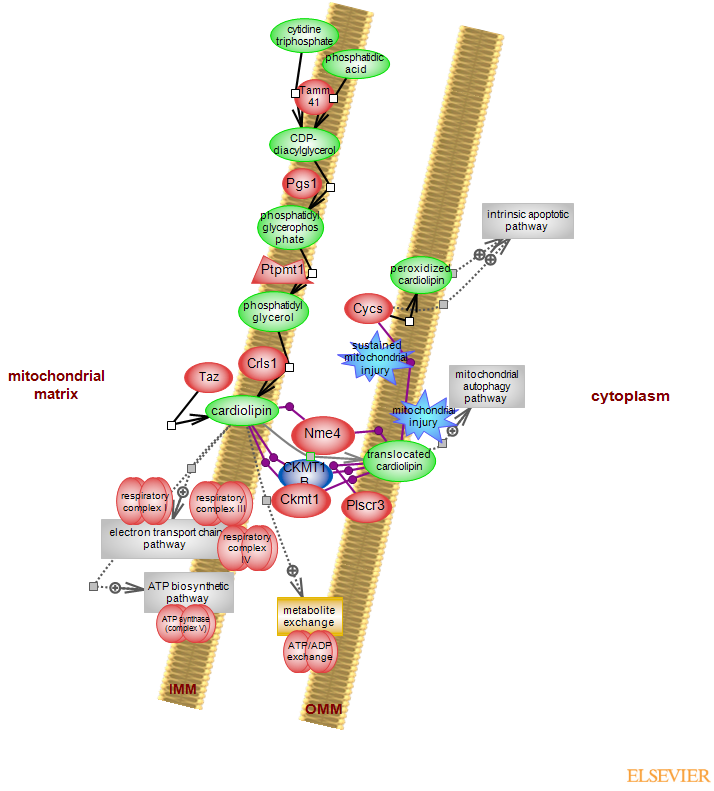
Cardiolipin (CL) is considered the signature phospholipid of the inner mitochondrial membrane (IMM) which is also the site of its synthesis. Structurally, CL is a lipid dimer with two phosphatidyl groups connected by a glycerol backbone. It has two chiral carbons and four fatty acyl chains, usually polyunsaturated. It can interact with various proteins that include components of the electron transport chain (ETC), enzymes and metabolite carriers. CL is found in the crystal structures of complex
III and complex IV of ETC pathway, of ADP/ATP carriers, and of several prokaryotic proteins. CL is required for optimal activities of complex I (respiratory complex I), III
( respiratory complex III), and IV (respiratory complex IV) and of ATP synthase, also referred to as complex V (ATP synthase). The transfer of electrons in ETC, also known as the respiratory chain, generates an electrochemical gradient that will drive the synthesis of ATP. ETC and ATP biosynthesis pathways are coupled in the overall oxidative phosphorylation (OXPHOX) pathway, but certain conditions will prompt uncoupling of the two. Likely, CL helps to properly embed the respiratory chain complexes within IMM. While ATP production is a major mitochondrial function, other important metabolic pathways reside in this organelle - the citric acid cycle, fatty acid beta degradation, heme and iron-sulfur clusters synthesis, and the urea cycle are notable examples. The exchange of metabolites between mitochondria and the cytoplasm is essential for the proper function of these pathways and several carriers and translocases are present in the IMM. Like in the case of respiratory complexes and ATP synthase, CL is also necessary for the optimal activity of carriers such as the phosphate, pyruvate and acylcarnitine and of ATP/ADP translocase. The translocase facilitates the movement of the synthesized ATP to the cytosol which is coupled to an antiport transport of ADP resulting in an 1:1 exchange of ATP for the external ADP. Like CL, the ATP/ADP system is abundant in the IMM and structural studies show two to three molecules of CL tightly bound to the carrier proteins. Interestingly, tetralinoleoyl-CL is the species that is required for the ATP/ADP function (ATP/ADP complex).
In the biosynthesis of CL, a series of four steps generate an initial CL molecule which then undergoes remodeling, through a deacylation-reacylation cycle that can follow several routes to produce the final, mature CL. The series of four reactions leading to the initial CL molecule is sometimes referred to as the 'de novo' synthesis. In the first step, the CDP-DAG synthase Tamm41 uses cytidine triphosphate and phosphatidylglycerol to form CDP-diacylglycerol. The phosphatidylglycerophosphate (PGP) synthase Pgs1 catalyzes the formation of PGP in the second step. Dephosphorylation of PGP to phosphatidylglycerol (PG)is carried out by Ptpmt1, a member of the protein tyrosine phosphatase family. In the fourth and final reaction CL is formed using PG and CDP-DAG by the cardiolipin synthase Crls1. At the end of the remodeling branch of the pathway, mature CL will have acquired a new set of fatty acids, the specificity of which varies between species, yet it only involves a few types of unsaturated acyl groups. If all four fatty acids are the same, CL is a symmetric molecule; the presence of a single different fatty acid residue renders the molecule asymmetric. The remodeling of CL may take place in compartments other than IMM, but the functional lipid is in the inner leaflet of IMM. The most important remodeling molecule is tafazzin (TAZ). Taz can account for all aspects of remodeling such as the removal and re-attachment of acyl groups and acyl specificity.
Translocation of CL to the outside of mitochondria involves several steps: movement from the inner to the outer leaflet of IMM (i), from the outer IMM leaflet to the inner OMM leaflet (ii) and from the inner to the outer leaflet of OMM (iii). While details of CL trafficking are still to be established, a flip-flop mechanism for intramembrane and the interaction with several proteins/complexes for intermembrane translocation are evidenced. For instance, nucleoside diphosphate kinase 4 (NME4) and mitochondrial creatine kinase bridge IMM and OMM and interact with CL. Translocation of CL from the inner to the outer OMM leaflet requires one of the phospholipid scramblases, PLSCR3. Likely, other protein/complexes participate in CL translocation such as the ATAD3 ATPase or the MINOS complex (not shown) but their exact role remains to be established.
Beyond remodeling, translocation of CL to the outer mitochondrial membrane (OMM)is a 'signal' of mitochondrial injury that depending on the magnitude, will trigger mitochondrial autophagy or mitophagy, or apoptosis, respectively. Externalized CL is recognized by component(s) of the autophageal machinery and this does not require CL modification. More sustained mitochondrial injury necessitating the induction of the apoptotic machinery and requires both CL presence in the OMM and its oxidative modification, specifically its peroxidation. Interestingly, this function is carried out by cytochrome c (CYCS) and is acquired through the interaction with CL. Cycs, which transfers electrons from respiratory complex III to complex IV and is also the master initiator of apoptosis, displays weak peroxidase activity as access of peroxide to the heme is hindered by the close proximity of Met80 to Fe. Binding of CL, prompts rearrangements in the hemoprotein resulting in the movement of Met80 away from the heme, weakening the bond between Fe and its sixth coordinating ligand and endowing Cycs with a peroxidase activity, CL-specific. Peroxidation of CL is essential for release of pro-apoptotic factors, including Cycs, into the cytosol. CL also interacts with proteins involved in mitochondrial fission. Mitochondria form dynamic networks whose morphologies change due to fission, fusion and redistribution. Lipids, including CL, play a role in the mitochondrial protein import machineries. Alterations in CL metabolism or structure are associated with several pathophysiological conditions. To see the ontology report for annotations, GViewer and download, click here...(less)