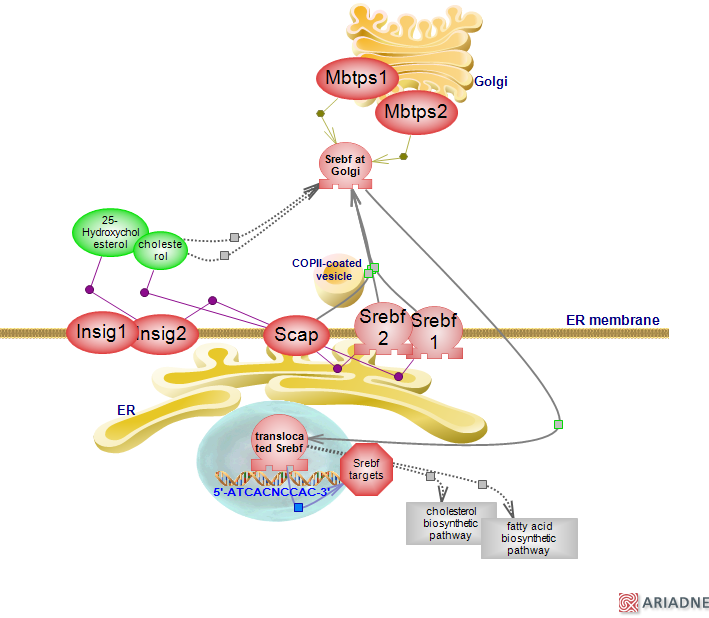
Sterol regulatory element-binding protein signaling pathway regulates lipid and cholesterol homeostasis via transcriptional targeting of genes such as LDL receptor and HMG-CoA reductase. HMG-CoA catalyzes the early, rate-limiting step in the cholesterol biosynthetic pathway. The sterol regulatory element binding proteins (SREBF or SREBP) represent a subfamily of basic helix-loop-helix leucine zipper transcription factors (bHLH-LZ) that have been conserved from fungi to man. In mammals, two genes
encode three and in rat four isoforms. A distinguishing feature of these proteins is the presence of a conserved tyrosine residue in the DNA binding domain. The tyrosine allows for binding to direct repeat variants of the inverted repeat E-box DNA motif, the usual bHLH-LZ canonical sequence. The direct repeat is also called sterol regulatory element (SRE).The proteins also harbor a large regulatory C-terminal domain containing two membrane-spanning helices. In species from yeast to man, the domain is involved in the interaction with the WD repeat domain of Scap (SREBP cleavage-activating protein). Scap is an escort protein for the transport of Srebfs from the ER to the Golgi apparatus in response to low levels of cholesterol. In the Golgi, the Srebf proteins are cleaved sequentially by Mbtps1 and Mbtps2 proteases, respectively. The N-termini, containing the bHLH-LZ DNA-binding and dimerization, and the transactivation domains, are liberated from the membrane and translocate to the nucleus. Cholesterol or sterols regulate the translocation of Srebfs from the ER to the Golgi by promoting the interaction of Scap with the ER membrane resident proteins Insig. The binding of cholesterol to Scap or of 25-hydroxycholesterol to Insig, promotes the interaction between Scap and Insig proteins leading to subsequent sequestration of Scap-Srebf complex in the ER. The interaction probably induces conformational changes in Scap that interfere with recognition of its sorting signal by the COPII coat proteins. When cholesterol and other sterol levels are low, Scap-Insig interaction is abolished; what follows is recognition of Scap by the COPII proteins, cargo loading into COPII vesicles and translocation to the Golgi where Srebf proteins can be processed to the active form. Translocation of Srebfs to the nucleus might involve an importin-beta dependent pathway. In the nucleus Srebf(s), in co-operation with other co-regulatory factors, initiate the transcription of several genes of lipid and cholesterol metabolism and of Inisg1. Of note is the fact that at least in mammals, the Srebf pathway appears to preferentially regulate fatty acid synthesis via Srebf1c, cholesterol biosynthesis via Srebf2 and both pathways via Srebf1a. Srebf1a and Srebf1c are two transcripts derived from Srebf1 gene. To see the Ontology Report for annotations, GViewer and download click here...(less)