|
|

|
LOSARTAN DRUG PATHWAY (PW:0001462)
Description
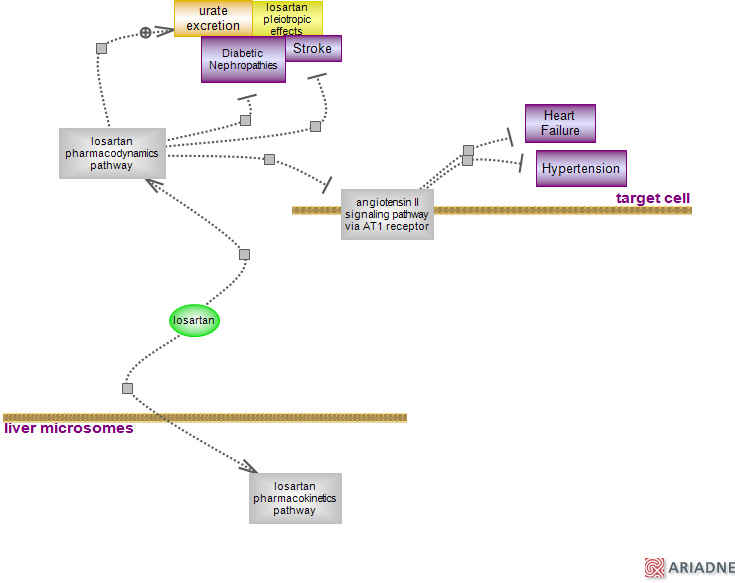
Losartan is a selective and competitive non-peptide antagonist of angiotensin II receptor type 1 (Agtr1) used in the treatment of hypertension and heart failure. Angiotensin II (AngII) is one of several and probably the most potent peptide generated by the renin-angiotensin cascade. AngII signals through two receptor types to elicit distinct responses. The Agtr1 mediated pathway is involved in vasoconstriction, proliferation, hormone release and fluid homeostasis. The powerful but potentially harmful effects elicited by Agtr1 are counterbalanced by the Agtr2 mediated signaling. This pathway promotes vasodilation, NO release and growth inhibition. The Agtr1 mediated pathway is the better understood one. Losartan is one of eight Agrt1 antagonists collectively known as ARBs that are clinically available; losartan is the first marketed and the most frequently prescribed. ARBs are effective antihypertensive agents; however, they exhibit differences in terms of pharmacokinetics properties and pleiotropic effects. The losartan parent compound has a rather moderate affinity for the receptor. Following rapid absorption, losartan is metabolized to the more potent metabolite E3174 via the E3179 intermediate. The affinity of E3174 for the Agtr1 is 20- to 30-times greater than that of losartan. Other minor metabolites are also produced that are less active than the parent compound. In humans, the main cytochrome P450 enzymes involved in losartan phase I biotransformation are CYP3A4 and CYP2C9 with CYP2C8 also contributing. The phase II biotransformation (glucuronidation) is carried out by the UGT1A1 and UGT2B7 enzymes. The ABCB1 member is involved in the efflux of losartan and metabolites. The Agtr1 receptor is a G-protein coupled receptor (GPCR) that couples to the Galphaq of heterotrimeric G proteins that activates phospholipase C; subsequent events lead to the activation of the protein kinase C (PKC) intracellular pathway. In the context of Agtr1, transactivation of epidermal growth factor/neuregulin and of Erk1/2 signaling as well as activation of the Jak-Stat pathway have been reported. The allelic variants of CYP2C9, depending on the identity of the variant, exhibit decreased formation of E3174 or seem to not affect the antihypertensive response. However, further investigations of this and other enzymes in the losartan pharmacokinetics pathway are necessary in order the assess the effect(s) of genetic variation on the therapeutic efficacy of the drug. Several amino acids have been identified as candidate components of the binding pocket of Agtr1. For losartan and probably E3174, these are serine 109, lysine 199 to a lesser extent, and asparagine 295 within transmembrane (TM) domains 3, 5 and 7 of the human receptor, respectively. These amino acids are conserved in the rat and mouse genes. In the model of the human receptor bound to its natural agonist, these positions are close to some of the positions the ligand uses and one position is identical. Given that the affinity of losartan (and other ARBs) matches the affinity of AngII, it is conceivable that the binding of antagonists interferes with the binding of the natural ligand. Losartan, in addition to its antihypertensive effects, may also slow down the progression of diabetic nephropathy, reduce renal disease progression in patients with type 2 diabetes (T2D) and decrease peripheral insulin resistance in T2D patients and animal models. Losartan also exhibits uricosuric action, possibly via inhibition of urate transporter 1, Slc22a12 known as URAT1 - one of several apical urate/anion exchangers involved in the reabsorption of urate in the proximal tubules. While some adverse side effects of ARBs have been reported, they are relatively rare. ...(less) |
Pathway Diagram:
|
|
|
Genes in Pathway:
|
|
| G
|
Ace
|
angiotensin I converting enzyme
|
|
ISO
|
|
SMPDB |
|
SMP:00162 |
NCBI chr10:91,410,129...91,430,246
Ensembl chr10:91,409,819...91,430,942
|

|
| G
|
Agt
|
angiotensinogen
|
|
ISO
|
|
SMPDB |
|
SMP:00162 |
NCBI chr19:69,426,540...69,447,017
Ensembl chr19:69,421,638...69,446,944
|
|
| G
|
Agtr1a
|
angiotensin II receptor, type 1a
|
|
TAS
ISO
|
|
SMPDB
RGD |
PMID:23487168 |
SMP:00162, RGD:7364969 |
NCBI chr17:34,383,397...34,435,523
Ensembl chr17:34,381,467...34,435,660
|
|
| G
|
Ren
|
renin
|
|
ISO
|
|
SMPDB |
|
SMP:00162 |
NCBI chr13:47,348,312...47,359,539
Ensembl chr13:47,348,143...47,359,543
|
|
|
|
| G
|
Abcb1a
|
ATP binding cassette subfamily B member 1A
|
|
ISO
|
|
RGD |
PMID:10725273 |
RGD:7364967 |
NCBI chr 4:26,312,403...26,488,456
Ensembl chr 4:26,312,409...26,397,135
|
|
| G
|
Cyp2c79
|
cytochrome P450, family 2, subfamily c, polypeptide 79
|
|
ISO
|
|
RGD |
PMID:23118328 |
RGD:7364964 |
|
|
| G
|
Cyp3a2
|
cytochrome P450, family 3, subfamily a, polypeptide 2
|
|
ISO
|
|
RGD |
PMID:21666702 |
RGD:7364965 |
NCBI chr12:14,321,771...14,343,886
Ensembl chr12:14,321,771...14,343,857
|
|
| G
|
Ugt1a1
|
UDP glucuronosyltransferase family 1 member A1
|
|
ISO
|
|
RGD |
PMID:18674515 |
RGD:7364966 |
NCBI chr 9:96,249,143...96,256,264
Ensembl chr 9:96,144,786...96,256,264
|
|
| G
|
Ugt1a2
|
UDP glucuronosyltransferase 1 family, polypeptide A2
|
|
ISO
|
|
RGD |
PMID:18674515 |
RGD:7364966 |
NCBI chr 9:96,239,019...96,256,264
Ensembl chr 9:96,144,786...96,256,264
|
|
| G
|
Ugt2b7
|
UDP glucuronosyltransferase family 2 member B7
|
|
ISO
|
|
RGD |
PMID:18674515 |
RGD:7364966 |
NCBI chr14:21,251,535...21,274,451
Ensembl chr14:21,251,535...21,274,451
|
|
|
|
|
Pathway Gene Annotations |
References Associated with the losartan drug pathway:
- Cabaleiro T, etal., Drug Metab Dispos. 2013 Jan;41(1):224-9. doi: 10.1124/dmd.112.046292. Epub 2012 Nov 1.
- Yang SH, etal., Acta Pharmacol Sin. 2011 Jul;32(7):967-72. doi: 10.1038/aps.2011.32. Epub 2011 Jun 13.
- Alonen A, etal., Biochem Pharmacol. 2008 Sep 15;76(6):763-72. doi: 10.1016/j.bcp.2008.07.006. Epub 2008 Jul 12.
- Soldner A, etal., Br J Pharmacol. 2000 Mar;129(6):1235-43.
- Michel MC, etal., Pharmacol Rev. 2013 Mar 13;65(2):809-48. doi: 10.1124/pr.112.007278. Print 2013 Apr.
- Bhuiyan MA, etal., Life Sci. 2009 Jul 17;85(3-4):136-40. doi: 10.1016/j.lfs.2009.05.001. Epub 2009 May 14.
- Stearns RA, etal., Drug Metab Dispos. 1995 Feb;23(2):207-15.
- Alonen A, etal., Bioorg Chem. 2008 Jun;36(3):148-55. doi: 10.1016/j.bioorg.2008.02.004. Epub 2008 Apr 1.
- Fillion D, etal., J Biol Chem. 2013 Mar 22;288(12):8187-97. doi: 10.1074/jbc.M112.442053. Epub 2013 Feb 5.
- Chrysant SG and Chrysant GS, J Clin Hypertens (Greenwich). 2006 Apr;8(4):261-8.
- Munger MA P T. 2011 Jan;36(1):22-40.
- Hamada T, etal., Am J Hypertens. 2008 Oct;21(10):1157-62. doi: 10.1038/ajh.2008.245. Epub 2008 Jul 31.
- Gibson TJ Curr Opin Rheumatol. 2013 Mar;25(2):217-22. doi: 10.1097/BOR.0b013e32835cedd4.
|
|
Ontology Path Diagram:
|
Import into Pathway Studio:
|
|