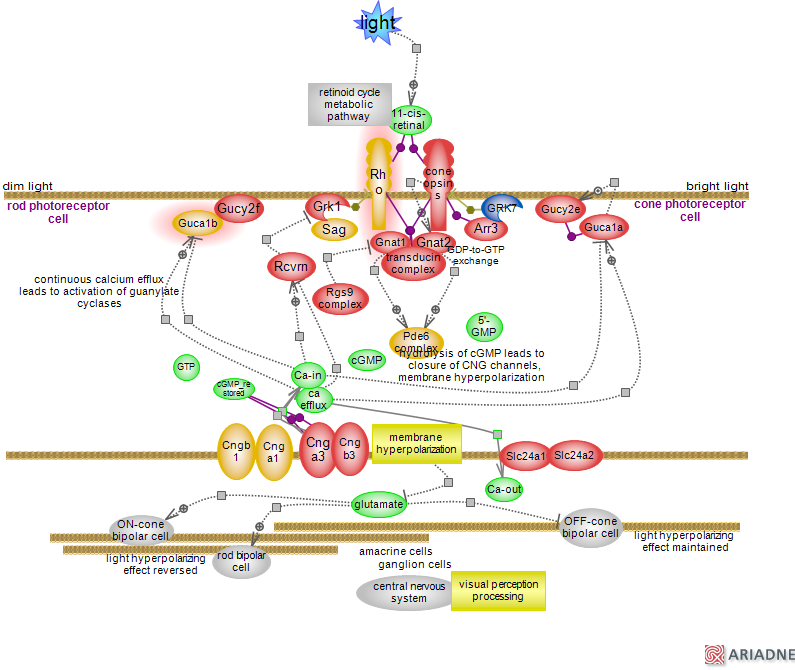
Photoreceptor cells are susceptible to cellular stress - their degeneration and loss is a major cause of blindness. Many genes have identified for the inherited and highly heterogeneous disorders resulting from photoreceptor degeneration. One of the most common form is retinitis pigmentosa (RP) and its patterns of inheritance are varied - some are autosomal dominant (adRP), others are autosomal recessive (arRP), a smaller fraction are X-linked (XLRP) and between 30 to 50% have not yet been class
ified. Other disorders include Bardet-Biedl syndrome (BBS), macular and age-related macular degeneration (MD, AMD), Leber congenital amaurosis (LCA), cone and cone-rod degeneration (CD, CRD). RP may occur alone or non-syndromic or in combination with other disorders, such as the Usher syndrome. Mutations in the same gene can cause different phenotypes, such as the many mutations in rhodopsin receptor (Rho) that cause adRP or arRP. Many RP mutations are in genes involved in the phototransduction and the metabolic visual cycle pathways. The response to light in the vertebrate retina is mediated by two photoreceptor types: the rods that mediate vision in dim light and the cones that mediate bright light and color vision. Both are G-protein coupled receptors (GPCR) that activate the specific heterotrimeric G protein transducin complex upon their own activation by the visual pigment - the vitamin A-derived 11-cis retinal. The one rod gene (Rho) and three cone genes are collectively known as opsins. To access the diagram for the normal visual phototransduction pathway, click here . Some 200 point mutations have been described for Rho and are associated with both adRP and arRP; they have been categorized into six classes with class I and II being the more common. Class I mutants are properly folded but mis-localized, class II mutants are misfolded (P23H is a most common adRP variant in North America), the remaining classes affect endocytosis (class III), stability and/or post-translational modification (class IV), increased activation of transducin (class V), constitutive activation of receptor (class VI), others are unclassified. Upon activation, transducin activates the cGMP phoshodiesterase (Pde) complex; the subsequent decrease in cGMP closes the cGMP-gated cation channels resulting in decreased calcium (Ca2+) influx. Mutations in rod-specific Pde and in cGMP-gated channels are associated with arRP. Decrease in intracellular Ca2+ also promotes the activation of guanylate cyclases and restoration of cGMP levels. The enzymes are constitutively bound to activator proteins (GCAPs), Ca2+ binding proteins that inhibit the cyclases in the presence of Ca2+ but stimulate them in its absence. Mutations in the guanylate cyclase activator gene Guca1b have been associated with adRP and with other forms of photoreceptor degeneration. GPCR signaling is controlled by several classes of proteins - the kinases that phosphorylate the activated receptors which are then recognized by arrestins whose binding preclude re-binding of G-proteins; at the G-protein level, by GTPase-activating proteins (GAPs) that increase the rate of G-protein GTP hydrolysis leading to inactivation of the Galpha subunit. Sag is a specific arrestin whose mutations have been associated with arRP. The genes whose mutations display a dominant RP phenotype are highlighted. In addition to the mutant genes in this and the visual cycle pathway, other RP and photoreceptor degeneration disorders associated genes affect process/pathway categories such as ciliary transport and channel activity, retinal development, metabolism and splicing (see other genes in RP in the disease pathway). Impairment of the phototransduction cascade combined with defective replenishing of the chromophore by alterations in the visual cycle metabolism. can result in decreased input to the visual cortex and diminished visual perception. Its augmentation with time may underlie the progressive degeneration of the photoreceptor and associated blindness. To see the ontology report for annotations, Gviewer and download, click here...(less)