Send us a Message


Submit Data |  Help |  Video Tutorials |  News |  Publications |  Download |  REST API |  Citing RGD |  Contact   
Pathways


Balancing Inflammatory Responses Pathway Suite Network

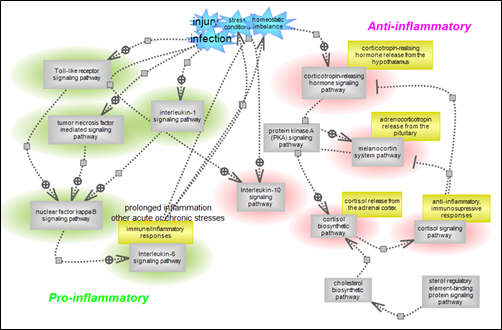
Living systems are exquisitely adroit at maintaining homeostasis despite constantly being challenged by environmental changes and stresses. One aspect involves rapid immune responses and the initiation of various pathways that underlie or relate to them. The other aspect relates to the timely suppression of these responses which, if prolonged, could become harmful, by prompting the pathways that counteract or control them. 

Nuclear factor kappa B signaling downstream of inflammatory cytokines,  Toll-like receptors and pro-inflammatory interleukins signaling prompted by infection and/or stresses result in the expression of many genes involved in immune and inflammatory responses along with cell survival, proliferation and differentiation.   On the other hand, the hypothalamus- pituitary-adrenal axis (HPA), via a relay of pathways, prompts the expression of cortisol or glucocorticoids whose signaling plays essential roles in the regulation of many important biological processes. Cortisol promotes the expression of anti-inflammatory proteins while repressing the expression of pro-inflammatory ones, and also providing a negative feedback loop for the HPA axis.In addition, the inflammatory response itself via both its stimuli and effects prompts the expression of the anti-inflammatory interleukins such as Il-10 and its subsequent signaling. A delicately balanced network of inter-related pathways and connecting regulatory loops underlie the pro- and anti- responses to maintain overall homeostasis.


Click here to explore the pro-inflammatory Nf-kappaB, Toll-like receptor, interleukins and related signaling pathways suite.

Click here to explore the pathway suite for the anti-inflammatory hypothalamus- pituitary-adrenal axis (HPA), interleukin-10 and related pathways.

Pro-inflammatory Nuclear Factor Kappa B, Toll-like Receptor, Interleukins and Related Signaling Pathways Suite

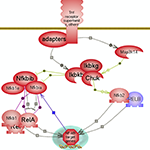
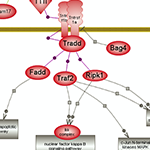
nuclear factor kappa B signaling pathway

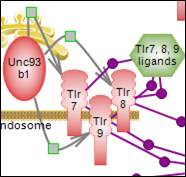
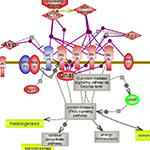
Toll-like receptor signaling pathway

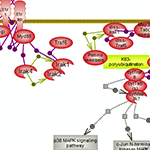
interleukin-1 signaling pathway


Nuclear factor kappa B signaling results in the expression of many genes
involved in the immune and inflammatory responses along with cell
survival, proliferation and differentiation, and many upstream signaling
pathways converge on its activation.  Click here to explore this important signaling pathway.
Toll-like receptors represent a first line of defense that responds to a
variety of exogenous and also endogenous stress molecules.  This causes
NF-kappaB signaling and also some of the MAPK cascades to be initiated.
Click here to explore this important defense system.
Interleukin-1 signaling plays important roles in innate and adaptive
immunity and is subject to tight control. The signaling initiated by
this potent cytokine activates Nf-kappaB and MAPK cascades. Click here to explore this complex signaling system.

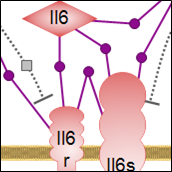
interleukin-6 signaling pathway

tumor necrosis factor signaling pathway


Interleukin-6, the best characterized member of a family of cytokines,
is involved in immune responses, inflammation, development, and the
hematopoietic and nervous systems. Il-6 signaling triggers Jak-Stat and
the Raf/Mek/Erk MAPK cascade.  Click here to explore the elements of the Il-6 pathway.
The tumor necrosis factor signaling pathway plays pivotal roles in
immunity, cell proliferation, differentiation and apoptosis. While also
being involved in the extrinsic apoptotic pathway, Tnf’s primary role is
pro-inflammatory and pro-growth and the major conduit is activation of
Nf-kappaB signaling.  Click here to explore the many facets of the Tnf signaling pathway.
Return to pathway suite network diagram

Anti-inflammatory HPA Axis, Interleukin-10 and Related Pathways Suite

Pathways of the HPA axis:

corticotropin-releasing hormone signaling pathway

melanocortin system pathway

Activation of the HPA axis triggers the release of corticotropin-releasing hormone (CRH) whose signaling via G-protein coupled receptors leads to activation of the protein kinase A (PKA) pathway and expression of the POMC gene. Click here to explore the details of this important pathway. Melanocortin peptides generated from processing of the POMC gene product set in motion the melanocortin receptors. Adrenocorticotropin (ACTH) is the sole ligand of receptor type 2 and the signaling pathway(s) set in motion culminate with the release of the glucocorticoid cortisol steroid hormone.  Click here to explore the complex features of melanocortin system signaling.

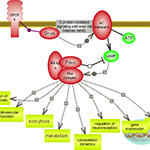
protein kinase A (PKA) signaling pathway

Protein kinase A (PKA) signaling is a widely-used intracellular pathway downstream of adenylyl cyclase activating heterotrimeric G proteins of the Galpha family. The receptors for CRH and melanocortin peptides couple to this family. Click here to explore the details of this important signaling relay.

cortisol biosynthetic pathway

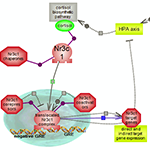
cortisol signaling pathway

Biosynthesis of cortisol happens primarily in the adrenal cortex in response to activation of the HPA axis. Click here to explore the details of this important metabolic pathway. Cortisol signaling via its receptor plays important roles in many
aspects of cellular and tissue physiology, is a potent anti-inflammatory
and immunosuppressive agent and provides a negative regulatory feedback
loop to the HPA axis.  Click here to explore the pathway involving this
steroid hormone receptor.
Return to pathway suite network diagram

HPA axis-related pathways and anti-inflammatory interleukin-10 signaling:

cholesterol biosynthetic pathway

sterol regulatory element-binding protein signaling pathway

interleukin-10 signaling pathway

Cholesterol, an essential component of cell membranes and lipids rafts,
is also the precursor for the synthesis of steroid hormones and bile
acids. The de novo synthesis of this 27 carbon lipid molecule from an
initial 2 carbon precursor requires some 30 reactions and its levels are
tightly regulated. Click here to explore this complex metabolic pathway.
                       Sterol regulatory element-binding protein signaling regulates lipid and cholesterol homeostasis. Click here to explore this important pathway mediated by the SREBP transcription factors.      The anti-inflammatory interleukin-10 is expressed in many immune cells
and while the signaling mechanisms accounting for it are not well
understood, interleukin-6 and -12 pathways may be amongst those
involved. Pathogenic microorganisms can also induce Il-10. Click here to explore this important signaling pathway.
Return to pathway suite network diagram


NHLBI Logo

NHLBI Logo

RGD is funded by grant HL64541 from the National Heart, Lung, and Blood Institute on behalf of the NIH.