Send us a Message


Submit Data |  Help |  Video Tutorials |  News |  Publications |  Download |  REST API |  Citing RGD |  Contact   
Pathways

Strains

RGD Strains

What is a strain?

Rats that are used in a laboratory come from different sources; most of these are derived from Rattus norvegicus. An inbred strain is one whose background can be defined and is named by nomenclature conventions. Normally, strains are. Normally, strains are named following the nomenclature guidelines. The official designation for a rat strain is a unique, brief symbol made up of letters or a combination of letters and numbers, and a laboratory code.


What types of strains does RGD have information about?

RGD currently houses information about strains of the following types:

advanced intercross line

chromosome altered

coisogenic strain

congenic strain

conplastic strain

consomic strain

hybrid strain

inbred strain

mutant strain

outbred strain

recombinant inbred strain

segregating inbred strain

transchromosomal strain

transgenic strain

wild


HINT:The Annotation icon will bring users to the ontology annotations report page to view all objects associated with the term.

Click here for definitions of the rat strain types.


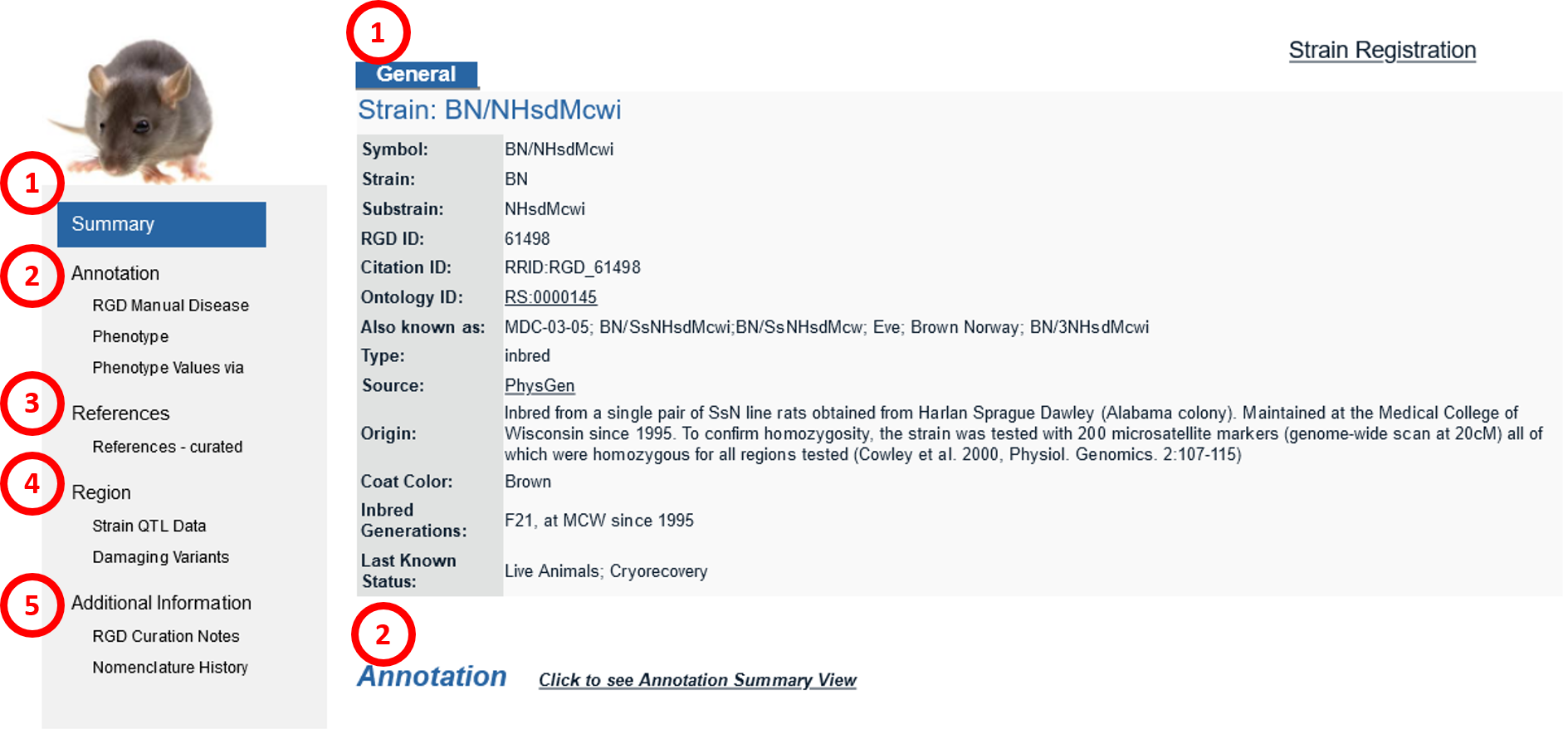
Symbol: This is the official symbol assigned to this strain according to the strain nomenclature guidelines. This is a combination of strain and substrain designations for inbred BN strain maintained at the Medical College of Wisconsin (Mcwi is the registered ILAR code for Medical College of Wisconsin).

Strain: The official strain symbol.

Substrain: The official substrain symbol – this can be a collection of ILAR lab codes defining the history of this particular strain. It can also be found in the pulldown section below with links to the strain report pages.

Full Name: If the strain has a text name then it is displayed here; this is not visible if no name is associated to the strain, as in this example.

RGD ID: This is the registered unique identifier associated with this strain. The symbol for the rat might be changing but the identifier stays the same.

Citation ID: This is the research resource identifier recommended from the “RRID Portal” https://scicrunch.org/resources. We recommend that you cite this ID (RRID:RGD_61498) in your publication so that the animal used in the study can be traced by readers.

Ontology ID: The identification number of the strain ontology term assigned by RGD, linked to the term in the ontology browser. In the strain ontology, rat strains are organized in a hierarchical fashion based on the type of strain and the way they were developed.

Alleles: The genetic markers associated with the strain (none in this example).

Also known as: Old symbols and synonyms that were used for the strain. If a strain is renamed to comply with the guidelines of strain nomenclature, then the symbol used by researchers is mentioned here.

Type: Description of the category of the strain – inbred, congenic, consomic, outbred, etc.

Source: The name of the lab, department, university or company where this particular strain can be obtained.

Origin: A brief description of the method used to generate this strain.

Coat Color: The coat color of this strain – e.g. Albino, brown, white.

Inbred Generations: The number of generations that this strain has been inbred at the time the data was curated.

Genetic status: The genotype of the strain.

Last known status: The availability of the strain as last known.

Position: The chromosomal positions of the genetic markers this strain carries.


2. Annotation

This section has subsections containing ontology annotations assigned to the strain. These are organized by ontology type, which includes the Disease Ontology and the Mammalian Phenotype ontology. The phenotype values via PhenoMiner contain information about quantitative phenotype analysis in the PhenoMiner tool. The default is the “Detail View” and can be changed to the “Summary View” for easy navigation.


Disease Annotations

RGD Manual Disease Annotations: These annotations represent disease to strain associations manually curated from the biomedical literature. The terms come from a combined Disease Ontology with customerized RGD disease terms. Disease annotations are followed by the evidence codes IAGP, IDA or IMP. The references from which these annotations were derived are listed by their identifiers created at RGD.


Phenotype Annotations

These annotations represent the association of strains with particular mammalian phenotypes.  The terms come from the Mammalian Phenotype Ontology developed at MGI (http://www.informatics.jax.org/Genome Biol. 6(1):R7. Epub 2004 Dec 15.) The terms are supported by the same group of evidence codes as used for disease vocabulary annotations.


Phenotype Values via Phenominer

This is a list of all the Phenotypes that are measured using this strain. These are retrieved from the RGD PhenoMiner tool, which houses quantitative phenotype data. Under Annotation Summary View, a click on ‘View chart’ goes to the PhenoMiner tool displaying the details of the phenotypes.  ‘Download data table’ opens a downloadable version of this data as an Excel spreadsheet and ‘View expanded data table’ gives an enhanced version of this data. Under ‘Annotation Detail View’ there is a table listing the strain, the measurements, experimental conditions and measurements used to annotate the strain.

3. References

References

A list of all references that have been used by the RGD curation team for annotating this strain. These link out to the RGD Reference report pages which have the abstracts of the articles. There is a link to PubMed from this page.

4. Region

This section contains Strain QTL Data and Damaging Variants analyzed from the tool Variant Visualizer. If it is a congenic strain, the Position Markers are listed in this section.


Strain QTL Data

This is a  list of QTLs that have been identified using this strain, and are annotated to it. The QTLs are linked to the RGD QTL report pages.


Damaging Variants

These are damaging variant reports from the strain. Clicking on the number brings up the details of the variants.


Position Markers

This section is visible only in the congenic strains that have SSLPs/genes/ESTs used as markers to define the introgressed segment.


This branch icon brings users to the ontology browser page which displays parent, sibling, and child terms, synonyms, and the graphical structure of the term relationships.


5. Additional Information

RGD Curation Notes (Strain Characteristics)

These are free text notes that give users information that is not captured by the disease and phenotype annotations, These are curated under the following headings:
Anatomy, Behavior, Characteristics, Drugs and Chemicals, Infection, Immunology, Life Disease, Physiology and Biochemistry, Reproduction and others.


Nomenclature History

This indicates when the strain was named and lists dates of any symbol changes.

Strain Curation Process at RGD

RGD curates the strains (inbred, congenic, consomics, etc.) that are mentioned in rat QTL papers. Besides this, the strains submitted to RGD from researchers and vendors are curated. RGD has regularly updated strain curation with targeted disease curation projects. Our curation team closely follows PubMed literature on genome-modified rats and disease models and makes them our curation priority. These searches bring lists of papers that are curated by the RGD team.

[back to report page top]


NHLBI Logo

NHLBI Logo

RGD is funded by grant HL64541 from the National Heart, Lung, and Blood Institute on behalf of the NIH.