Send us a Message


Submit Data |  Help |  Video Tutorials |  News |  Publications |  Download |  REST API |  Citing RGD |  Contact   
Pathways


Prostate Cancer Pathway Suite

Prostate cancer is a common and sometimes deadly disease that affects approximately 1 in 5 men.  Because both normal and malignant tissues rely on the action of androgen hormones for growth and proliferation, the androgen signaling pathway and its corollary the altered androgen signaling pathway are inextricably linked to the steroid hormone biosynthetic pathway in general, and more specifically, the testosterone biosynthetic pathway upstream and the prostate cancer disease pathway downstream.  To explore the complex of relationships between these pathways and their constituents, begin by clicking any of the pathway links below.

To view genes, QTLs and strains associated with Prostate and other cancers, click here to explore the Cancer Disease Portal.

For more about steroid hormone biosynthesis, click here to access the Steroid Hormone Biosynthesis Pathway Suite.
Normal Pathways:

Steroid hormone biosynthetic pathway


Testosterone biosynthetic pathway


Androgen signaling pathway

         
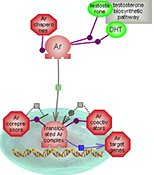
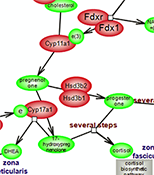
Steroid hormones play important roles in metabolism, growth and differentiation and in reproductive functions, and their synthesis and release are highly regulated.  Click here to explore how the precursor cholesterol is converted into these vital hormones.   Testosterone, the main androgen hormone, has major roles in the development and maintenance of the male phenotype and reproductive functions as well as functioning in a range of other processes in nonreproductive tissues.  Click here to explore the specific pathway from cholesterol to this important hormone and its potent metabolite dihydrotestosterone.   The androgen signaling pathway plays important roles in the development and maintenance of the male phenotype and reproductive functions and in a range of other processes in nonreproductive tissues.  Click here to explore the downstream effects of this important pathway, and the complex network of regulators that impact its function.

Altered Pathways:

Altered androgen signaling pathway

 Altered p53 signaling pathway

Prostate cancer pathway


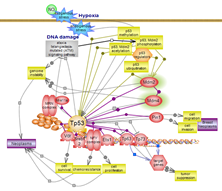
Alterations in the androgen signaling pathway, primarily at the level of the receptor, have been associated with the development and progression of prostate cancer.  Click here to explore how changes to various components of this vital pathway impact its ability to function normally, and how they can lead to prostatic neoplasms.  The p53 tumor suppression transcription factor, many times referred to
as the ‘guardian of the genome’ or as the ‘cellular gatekeeper’, is at
the hub of many signaling and regulatory networks. p53 is one of the
most commonly mutated genes in cancer. While some mutations are missense
or frameshift, resulting in loss of expression, as usually seen for
other tumor suppressors, most of the mutations in p53 are missense. Many
cluster within the DNA binding domain (DBD), with six prominent
‘hotspots’ identified.  Click here to explore the details of the altered version of this vital signaling pathway.
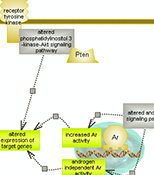
Prostate neoplasm is a common form of cancer affecting about 1 in 5 men.  Click here to explore how changes in the PI3-kinase/Akt and androgen signaling pathways can lead to neoplastic changes in the prostate.  


NHLBI Logo

NHLBI Logo

RGD is funded by grant HL64541 from the National Heart, Lung, and Blood Institute on behalf of the NIH.