| Mismatch repair pathway
|
Nucleotide excision repair pathway
|
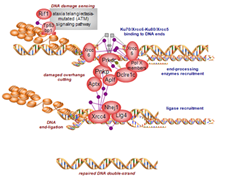
Non-homologous end joining pathway of double-strand break repair
|
Homologous recombination pathway of double-strand break repair
|
| DNA mismatch repair (MMR) is a highly conserved pathway to assure the correct base matching of the duplex. Mismatches may be introduced during DNA replication and could be deleterious if not promptly removed. Well characterized in E. coli and S. cerevisiae in eukaryotes, the molecular details of MMR in higher eukaryotes are still to be deciphered. Alterations in MMR have been implicated in colorectal and several other forms of cancer. Click here to explore this important repair pathway. | The nucleotide excision repair (NER) pathway detects distortion of the double-helix and leads to removal of an entire DNA segment. It occurs in two flavors that differ in the first step of lesion recognition. The transcription-coupled TC-NER deals with the repair of lesions within the transcribed strand whereas the global genome GG-NER repairs lesions throughout the genome. Inborn defects in several NER proteins have been associated with skin cancer-prone and premature aging-like diseases. Click here to explore this important repair system. |
Non-homologous end-joining (NHEJ) is the predominant |
Homologous recombination (HR) pathway of double-strand break repair is error free and restricted to the S and G2 phases of the cell cycle when sister chromatids are available. HR mediated break repair proceeds via three final routes: break-induced replication (BIR), double Holliday junction (dHJ) and synthesis-dependent strand annealing (SDSA). Click here to explore this double-strand repair pathway. |



| Ataxia telangiectasia-mutated (ATM) signaling pathway
|
p53 signaling pathway
|
Intrinsic apoptotic pathway
|
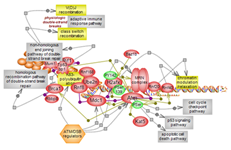
| Ataxia telangiectasia-mutated (ATM) serine/threonine kinase has an impressive repertoire of substrates likely underlying the range of responses it prompts. ATM signaling proceeds via several overlapping layers and is accompanied by activating positive feedback and regulatory inhibitory loops. Two downstream sensors – Tp53bp1 and Brca1 prompt NHEJ or HR double-strand repair pathways, respectively. The two antagonize each other via molecular mechanisms that are incompletely understood. Directly or via effectors, ATM promotes p53, checkpoints and apoptotic pathways. As the name suggests, the human gene is mutated in the autosomal recessive condition associated with neurodegenerative and immunodeficiency phenotypes. Click here to explore this complex signaling pathway. | The p53 tumor suppressor transcription factor pathway represents a critical node of cellular homeostasis. P53 is target for many regulators and in turn, directly or indirectly regulates hundreds if not thousands of RNA polymerase II-transcribed genes, both protein-coding and non-coding. It binds and bends DNA and the DNA-bound recruits histone modifying enzymes and subsequent chromatin loosening. P53 is mutated in many types of cancer and many of the mutations appear to ‘cluster’ within the DNA binding domain (DBD). Click here to explore this very important signaling pathway. | Programmed cell death, or apoptosis, removes excess or damaged cells to maintain tissue homeostasis. Of the two types, the extrinsic pathway is triggered by ligands activating the death receptors whereas the intrinsic (mitochondrial) pathway is triggered by intracellular stresses. Both converge in the activation of executioner caspases. Alterations of the intrinsic apoptotic pathway have been associated with a range of conditions. Click here to explore this important regulatory pathway. |


Return to pathway suite diagram
|
|
||
|
|
|
|