Send us a Message


Submit Data |  Help |  Video Tutorials |  News |  Publications |  Download |  REST API |  Citing RGD |  Contact   
Pathways

Pathway Suite for the Metabolism of Glucose and Related Molecules Pathways

Glucose is a vital cellular fuel and constitutes the main energy source for the brain. The levels of glucose on both a cellular and a systemic scale are controlled by a complex network of metabolic, regulatory and signaling pathways.  This suite of interactive pathway diagrams covers aspects of glucose metabolism.

Click here to explore the glucose homeostasis-related regulatory and signaling pathways which also contribute to the delicate balance of glucose homeostasis in the body.

Disregulation of a number of glucose homeostasis-related metabolic, regulatory and signaling pathways has been linked to Type 2 Diabetes.  Click here to explore the Type 2 Diabetes Pathway Suite for more information on pathways of relevance to this condition.
To link to the Diabetes Disease Portal, click here
Glucose Oxidation and Conversion

Glycolysis pathway

Pyruvate metabolic pathway

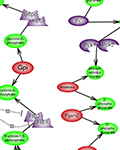
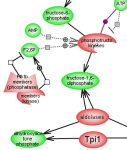
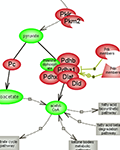
Glycolysis represents the first round of glucose breakdown whose end product, pyruvate can have multiple fates. Click here to explore how glucose is converted to pyruvate in one of the best characterized biochemical pathways. Pyruvate metabolism plays a central role in glucose and energy homeostasis. Pyruvate can be converted to acetyl-CoA, the precursor of the energy producing citrate cycle, but also of energy storing fatty acid biosynthesis or to oxaloacetate, a citrate cycle intermediate and precursor of gluconeogenesis. Click here to explore this important intersection node of several metabolic pathways.

Pentose phosphate pathway

Hexosamine biosynthetic pathway

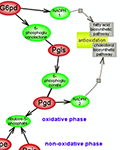
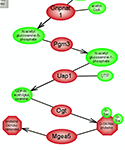
This pathway represents an alternate route of glucose oxidation accounting for ~10-20%. It produces reducing equivalents and a precursor for nucleotide and nucleic acid synthesis. Click here to explore this important metabolic pathway. Approximately 2-5% of the fructose-6-phosphate, the isomer of glucose-6-phosphate, is diverted to the production of UDP-N-acetylglucosamine rather than being converted to pyruvate via glycolysis. UDP-GlcNAc is the unique donor for the O-linkage of a single N-acetylglucosamine (O-GlcNAc) to many cytoplasmic and nuclear proteins. Click here to explore the biosynthetic pathway of this important modulator that, by virtue of the broad functionality of its targets, many consider a signaling molecule.

Glucose storage

Glycogen biosynthetic pathway

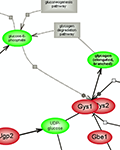
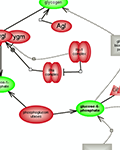
Metabolism of glycogen, the storage form of glucose, takes place primarily in the liver and muscle. Muscle glycogen is used to provide local energy while glycogen in the liver supplies fuel to extrahepatic tissues. Click here to explore this important metabolic pathway.

Glucose Biosynthesis

Gluconeogenesis pathway

Glycogen degradation pathway

Glucose synthesis, via gluconeogenesis, occurs when the liver storage has been depleted of its glycogen supply and/or glucose is not available from dietary sources. Click here to explore this important metabolic pathway. Glycogenolysis in muscle is used directly as a source of energy for that tissue whereas glycogenolysis in liver produces glucose which is then exported for use by extrahepatic tissues and organs such as the brain. Click here to explore this vital metabolic pathway.


NHLBI Logo

NHLBI Logo

RGD is funded by grant HL64541 from the National Heart, Lung, and Blood Institute on behalf of the NIH.