Send us a Message


Submit Data |  Help |  Video Tutorials |  News |  Publications |  Download |  REST API |  Citing RGD |  Contact   
Pathways

Pathway Suite for the Glucose Homeostasis-related Regulatory and Signaling Pathways

Glucose is a vital cellular fuel and constitutes the main energy source for the brain. The levels of glucose on both a cellular and a systemic scale are controlled by a complex network of metabolic, regulatory and signaling pathways. This suite of interactive pathway diagrams covers signaling and regulatory pathways pertinent to glucose homeostasis.

Click here to explore the metabolic pathways involved in glucose oxidation and conversion which also contribute to the delicate balance of glucose homeostasis in the body.

Disregulation of a number of glucose homeostasis-related metabolic, regulatory and signaling pathways has been linked to Type 2 Diabetes.  Click here to explore the Type 2 Diabetes Pathway Suite for more information on pathways of relevance to this condition.
To link to the Diabetes Disease Portal, click here
Regulatory pathways

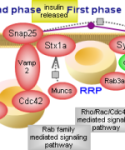
Insulin secretion pathway

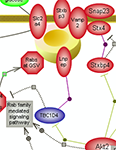
Insulin responsive facilitated sugar transporter mediated glucose transport pathway

In response to elevated glucose, pancreatic beta cells release insulin. Insulin secretion is biphasic:  an initial “triggering” phase dependent on ATP-sensitive potassium channels is followed by an “amplifying” phase largely independent of KATP channels. Click here to explore this vital and complex regulatory pathway. Uptake of glucose in the heart, skeletal muscle and adipose tissues is mediated by the Slc2a4/Glut4 transporter.  Insulin prompts trafficking of transporter-containing vesicles to the plasma membrane where exocytosis increases the Glut4 at the membrane.  The PI3K-Akt pathway downstream of the insulin receptor may play a role via Akt2. Click here to explore this essential component of glucose homeostasis.

Signaling Pathways

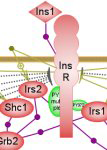
Insulin signaling pathway

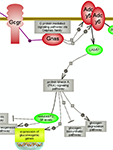
Glucagon signaling pathway

Secreted insulin binds to its receptor to initiate a signaling pathway which plays essential roles in both glucose and energy homeostasis. The pathway activates two intracellular cascades – the PI3K-Akt and Raf/Mek/Erk MAPK pathways – to ultimately carry out insulin’s downstream effects. Click here to explore this important signaling pathway and the cascades it triggers. In response to low glucose, pancreatic alpha cells release glucagon by incompletely understood mechanisms. Glucagon signaling activates the protein kinase A (PKA) pathway to stimulate glucose-producing, while inhibiting glucose-consuming, metabolic pathways. Click here to explore this important signaling network.


NHLBI Logo

NHLBI Logo

RGD is funded by grant HL64541 from the National Heart, Lung, and Blood Institute on behalf of the NIH.