Send us a Message


Submit Data |  Help |  Video Tutorials |  News |  Publications |  Download |  REST API |  Citing RGD |  Contact   
Pathways


Beta Adrenergic Receptor Pathway Suite

The catecholamine epinephrine is the preferred natural agonist for the beta adrenergic receptors, Adrb1, Adrb2 and Adrb3. Although the Adrb1 and Adrb2 receptors are important for normal cardiac function, acute stimulation can lead to cardiac failure if it becomes chronic.  This observation has led to the development of beta blockers, a class of drugs which counteract such excessive signaling and thus are commonly used to protect the heart from the adverse affects of MI, cardiac arrhythmias and hypertension.  On the other hand, in the treatment of asthma beta agonists are used to target the beta2 receptor to stimulate its bronchodilator function.

This suite of interactive pathway diagrams covers several aspects of the epinephrine and beta adrenergic receptor system.  Click any of the links below to explore the pathways of epinephrine synthesis, its signaling via beta receptors and the blockers and agonists that affect the functioning of its receptors.
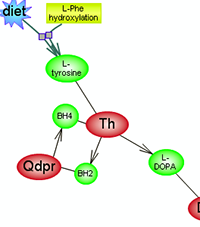
Epinephrine biosynthetic pathway

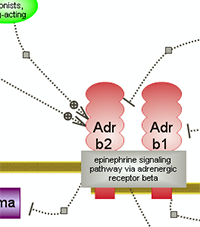
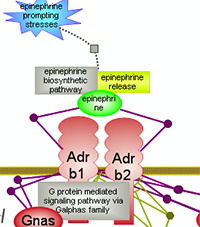
Epinephrine signaling via beta adrenergic receptors

Adrenergic beta receptor agonist and beta-blocker pharmacodynamics pathway

Epinephrine Biosynthetic Pathway Epinephrine Signaling via Beta Adrenergic Receptors Adrenergic Beta Receptor Agonist and Beta-Blocker Pharmacodynamics Pathway
Epinephrine and norepinephrine are synthesized and released in response to various but distinct stresses. Epinephrine is the last molecule in the serial, yet localized, biosynthesis of catecholamines. Click here to explore how the precursor L-tyrosine is converted to these important neurotransmitters and hormones. Epinephrine and norepinephrine signal via various adrenergic receptors, G-protein coupled receptors that interact with distinct alpha subunits of the heterotrimeric G proteins. Epinephrine is the preferred agonist for the beta adrenergic receptors.  Click here to explore this important signaling pathway and its downstream effects. Of the three beta receptors, beta1 and beta2 are the better understood systems. Due to its role in smooth muscle relaxation, the beta2 receptor is the target of both short- and long-acting agonists used in the treatment of asthma. Both receptors are important for normal cardiac function but, if chronically stimulated, can lead to heart failure. As such, the “beta-blocker” antagonists are commonly used as therapeutics. Click here to explore these drug pathways and their components.


NHLBI Logo

NHLBI Logo

RGD is funded by grant HL64541 from the National Heart, Lung, and Blood Institute on behalf of the NIH.